

Passive House
Passive House - the gold standard of construction
Passive House, known internationally as Passivhaus, is the world’s leading energy performance standard for buildings. Developed in Germany in the early 1990s, it's now used in over 60 countries and has been applied to tens of thousands of buildings, from single houses to apartment blocks, schools, high rise and hospitals.
The standard focuses on creating buildings, in our case, homes that are exceptionally comfortable, healthy and energy efficient. Rather than relying heavily on heating and cooling systems, a Passive House is designed and built with intention, using high levels of insulation, airtight construction, high performance windows, thermal bridge free detailing and continuous fresh air ventilation. The result is a home that maintains a stable indoor temperature, filters fresh air, reduces condensation and mould risk, and uses significantly less energy to run. For homeowners, Passive House is about more than efficiency; it is about living in a quieter, healthier and more comfortable home, built to perform for the lifetime of the home.
It's not a brand, a product, or a style. It's a rigorous, physics-based building standard, modelled and verified by independent certification. When a building achieves Passive House certification, you know the home will perform exactly as designed.

The five principles of Passive House
Passive House isn't one magic trick, it's five principles working together as a system. Remove one, and the whole house underperforms. Get all five right, and the result is extraordinary.
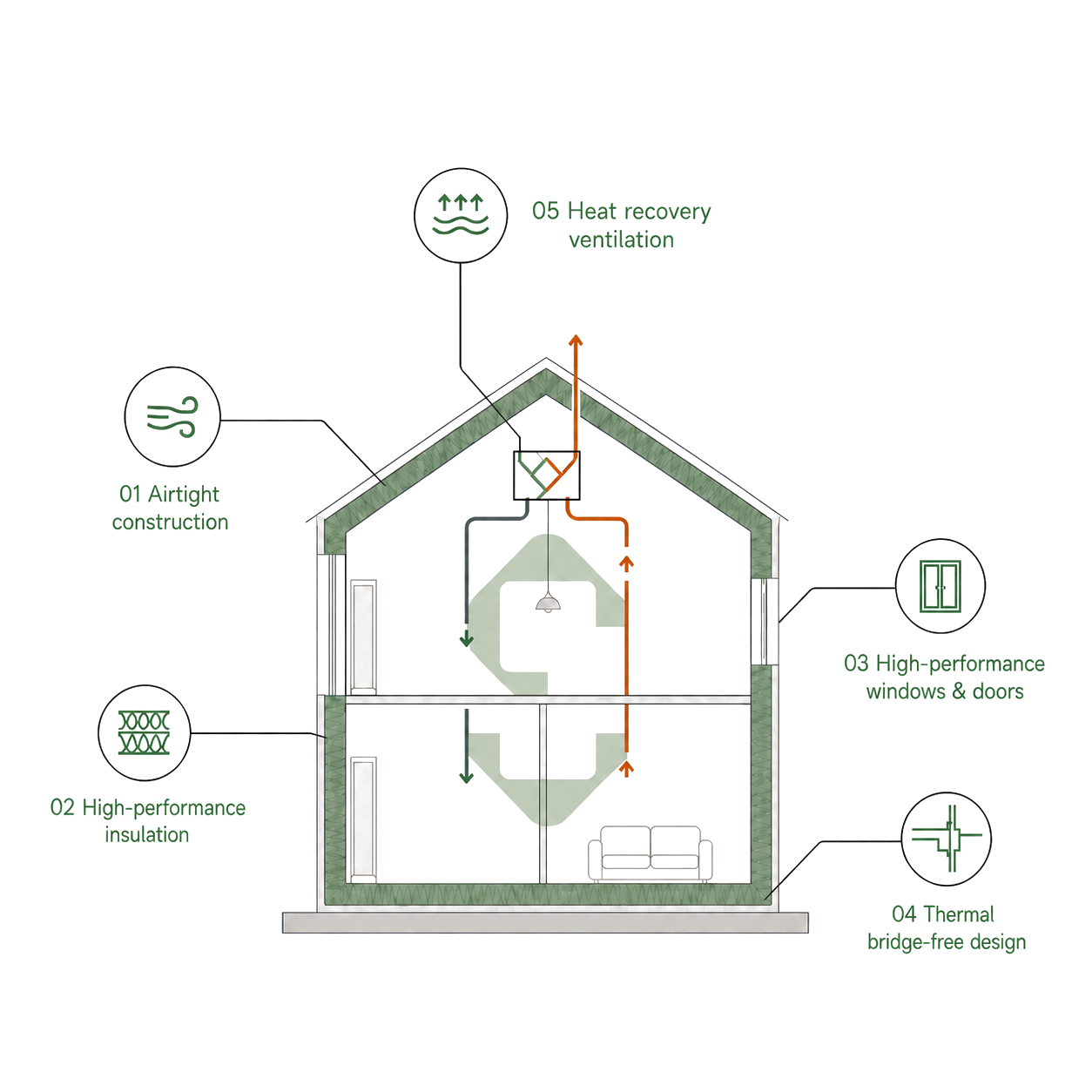
-
01
Airtight Construction
Airtightness is one of the key foundations of Passive House performance. By carefully sealing the building envelope and minimising uncontrolled air leakage, the home can maintain a more stable internal temperature, reduce drafts, improve energy efficiency and better control moisture movement through the structure.
-
02
High Performance Insulation
A Passive House uses carefully designed, continuous insulation to create a strong thermal envelope around the home. This reduces heat loss in winter and heat gain in summer, helping the building maintain comfort with very little reliance on mechanical heating or cooling.
-
03
High Performance Windows and Doors
Windows and doors are specified to suit the climate, orientation and performance requirements of the home. Double or triple glazing, insulated and thermally broken frames and careful installation help reduce unwanted heat transfer, improve internal surface temperatures and support year round comfort.
-
04
Thermal Bridge-Free Detailing
Thermal bridges occur where heat can bypass the insulation layer through structural elements, junctions or poorly detailed connections. Passive House design aims to eliminate or significantly reduce these weak points, improving energy performance, reducing condensation risk and protecting the long-term durability of the building fabric.
-
05
Mechanical Ventilation with Heat Recovery
Because a Passive House is built to be highly airtight, fresh air is supplied through a mechanical ventilation system with heat recovery. This system continuously removes stale, moist air and replaces it with fresh, filtered air, while transferring heat between the outgoing and incoming air streams to reduce energy loss and maintain a healthy indoor environment.
The Difference
Passive House vs. a standard Australian home.
Two homes can sit on neighbouring blocks, look identical from the street and perform worlds apart. The numbers below show how a certified Passive House compares to a typical 6-Star NatHERS build.
In practical terms, the Passive House is designed to feel comfortable year round, warm enough in winter that you can walk around in just a t-shirt and without slippers and cool enough in summer without relying on the air conditioner running flat out. With dramatically reduced heating and cooling demand, with a Passive House usually being net zero, it can save homeowners thousands of dollars over the life of the home, while also creating a healthier and more stable indoor environment. Fresh, filtered air is supplied continuously throughout the year, without needing to open windows in the middle of winter or summer. The careful control of temperature, moisture, airflow and thermal bridges remove the risk of condensation and mould, while a well-detailed weather-resistant barrier provides a second layer of defence to help protect the structure. The result is a home that is not only more comfortable and efficient, but one designed to protect both your health and your asset for your lifetime.
| Feature | Standard home (6-Star NatHERS) | Passive House |
|---|---|---|
| Heating demand | ~120 kWh/m²/year | ≤15 kWh/m²/year |
| Airtightness | Not tested (typically 15+ ACH@50Pa) | ≤0.6 ACH@50Pa (tested & verified) |
| Ventilation | Open windows / exhaust fans | MVHR with 90% heat recovery |
| Thermal bridges | Common (steel lintels, concrete slabs) | Designed out entirely |
| Windows | Single or double glazed, aluminium frames | Double/triple glazed, thermally broken frames |
| Comfort | Variable, depends on heating and cooling use | Consistent 20–25°C year-round |
Certification
Certified to the standard we build to.
Our founder, Emile Ellens, is a Certified Passive House Tradesperson, accredited by the Passive House Institute, the body that created and governs the Passive House Standard. SV Built is also a member of the Australian Passivhaus Association. It means the people detailing and building your home have been examined against the same standard the home is certified to. We build to the standard we are certified in. Verify the certification.


Further Reading
- Philosophy Why every new home should be built to Passive House principles.
- Construction How a Passive House is built to the standard in Adelaide
- Construction How much does a Passive House cost to build in Adelaide?
- Philosophy What is a high-performance home in Adelaide?
- Construction Why doesn't my new home perform the way it was rated?
- Construction The real cost of airtightness — and why it pays you back.
More in the journal, or wider reading from the Australian Passivhaus Association and the Sustainable Builders Alliance. To see how Passive House fits within a healthy home, read our approach.
FAQ
Passive House questions.
- What is a Passive House?
- A Passive House is a building built to a rigorous, physics-based energy standard developed in Germany in the early 1990s and now used in over 60 countries. It combines continuous insulation, airtight construction, high-performance windows, thermal-bridge-free detailing and mechanical ventilation with heat recovery to hold a stable, comfortable indoor temperature using very little energy. It is independently modelled and certified — not a style or a product.
- How much does a Passive House cost to build in Adelaide?
- A certified Passive House typically adds around 10–20% over a comparable standard build, depending on the design, the site and how far the home pushes beyond the standard. Much of it is recovered over the life of the home through far lower running costs — a Passive House targets ≤15 kWh/m²/year for heating against roughly 120 for a typical build. We give every client a clear, itemised cost picture before committing.
- Is a Passive House worth it in Adelaide’s climate?
- Yes. Adelaide’s hot, dry summers and cool winters are exactly where a Passive House earns its keep. The airtight, well-insulated envelope keeps heat out in summer and in during winter, so the home stays close to 20–25°C year-round with minimal heating or cooling. Continuously filtered fresh air also helps in a climate with bushfire smoke and high pollen.
- What is a blower-door test?
- A blower-door test measures how airtight a building is by pressurising it and measuring air leakage. Passive House requires a verified result of ≤0.6 air changes per hour at 50 pascals (ACH50) — proven, not assumed. A typical Australian home is rarely tested and often leaks at 15+ ACH50.
- Do you have to keep the windows closed in a Passive House?
- You can open windows whenever you like — the difference is that you never have to. A Passive House supplies continuous filtered fresh air through a mechanical ventilation system with heat recovery (MVHR), so the air stays fresh and the temperature stable even with everything closed. That matters on a 40°C day, a cold night, or when there is smoke or pollen outside.
- How is a Passive House different from a 7-star NatHERS home?
- NatHERS rates a design’s modelled thermal performance; Passive House sets a verified performance standard for the finished, built home and tests it. A higher NatHERS star rating is a real improvement on minimum code, but Passive House goes further — airtightness is measured, ventilation is mechanical with heat recovery, thermal bridges are designed out, and the result is independently certified.
- Is Passive House the same as sustainable or green building?
- It overlaps but is more specific. Sustainable building is a broad goal; Passive House is a precise, measurable standard for energy performance, comfort and air quality. A Passive House is inherently low-energy, which makes it a strong foundation for a sustainable, healthy home — but the term refers to the verified building standard, not a general aspiration.


